
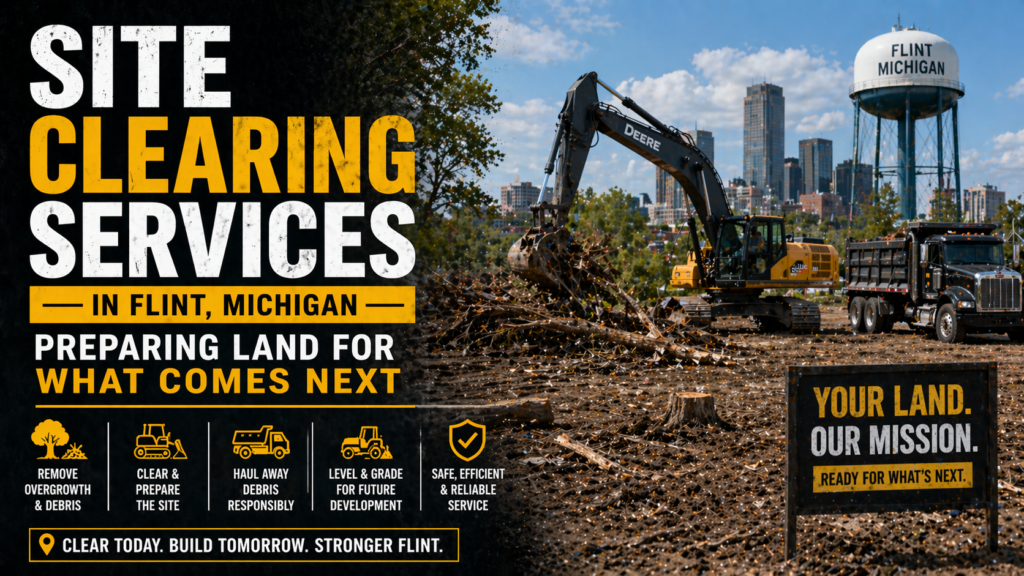
Every construction project, renovation, or land development begins with the same essential step: clearing the site. Before a foundation can be dug, before equipment can move freely across a property, and before any building materials arrive, the land must be made ready. In Flint, Michigan, site clearing is a skilled trade that combines heavy equipment operation, environmental awareness, and careful coordination with the broader project goals.
This article examines what Site Clearing Services Flint involve, why they are critical to project success, and how the specific conditions of the Flint area shape this type of work.
What Is Site Clearing?
Site clearing is the process of removing all surface material from a parcel of land that would obstruct or interfere with construction. Depending on the condition of the site, this can include:
Trees and large vegetation from individual mature trees to dense woodland cover.
Brush, shrubs, and undergrowth that may be less visible but still require removal before grading equipment can operate effectively.
Stumps and root systems, which can be particularly challenging because they extend well below the surface and must be removed thoroughly to prevent future settlement.
Debris, rubble, and existing surface materials from prior structures or activities.
Old concrete pads, foundations, or hard surfaces that were part of prior construction.
Fencing, poles, and other site fixtures.
The goal of site clearing is to leave a property in a condition where subsequent work grading, excavation, foundation installation can proceed without obstruction and on a consistent, measurable surface.
Why Site Clearing Matters Beyond Simple Cleanup
Site clearing is sometimes treated as a purely mechanical task bring in equipment, remove what is in the way, move on. In practice, it is a process that has lasting consequences for everything that follows.
Root Systems and Soil Stability When trees are removed from a site without proper stump and root extraction, the decomposing root systems leave voids in the soil. As roots break down over years, these voids cause soil to settle unevenly, which can result in foundations cracking, paved surfaces sinking, and drainage channels shifting. Complete root removal during site clearing prevents these long-term problems.
Drainage Establishment Heavy vegetation on a site naturally intercepts rainwater and slows runoff through root absorption. When that vegetation is removed, the bare soil is temporarily more vulnerable to erosion from rainfall. Quality site clearing includes consideration of how the newly exposed ground will manage water during the period between clearing and construction, which sometimes involves temporary erosion control measures.
Proper Waste Management The material generated by site clearing trees, brush, stumps, debris must be handled appropriately. Some material can be chipped into mulch on-site or used as fill. Other material, particularly if it contains construction debris or potentially contaminated soil from prior industrial use, must be handled according to Michigan environmental regulations. In Flint’s context, where the city has a significant industrial history, this consideration is particularly relevant on properties that were previously used for commercial or manufacturing purposes.
Site Access Partially cleared or poorly cleared sites create obstacles for subsequent work crews. A properly cleared site allows grading equipment, concrete trucks, material deliveries, and inspection personnel to move across the property safely and efficiently.
Site Clearing in the Context of Flint’s Land History
Flint, Michigan carries an industrial heritage shaped by decades of automotive manufacturing activity. The city and surrounding Genesee County have seen significant changes in land use over the past several decades, including the closure of manufacturing facilities and the redevelopment of previously industrial sites. This history is relevant to site clearing for several reasons.
Sites that were previously used for industrial or commercial purposes may have buried structures, underground storage tanks, or contaminated soil that needs to be identified and properly managed before clearing and excavation can proceed. Environmental assessments commonly called Phase I or Phase II Environmental Site Assessments are often conducted on commercially acquired properties to identify these conditions before construction begins.
The Genesee County Land Bank has also been active in clearing blighted and abandoned structures throughout Flint and the county. Properties that have passed through blight elimination programmes may have had structures demolished but may not have undergone full site clearing for new construction purposes. The distinction matters: demolition clears what is above ground, while full site clearing and preparation addresses what remains at and below the surface level.
Equipment Used in Site Clearing
Professional site clearing contractors rely on a range of heavy equipment to perform the work efficiently and safely:
Bulldozers The workhorse of large-scale site clearing, bulldozers push material across the surface and can uproot vegetation and debris with their blades.
Excavators Highly versatile, excavators can remove stumps, dig out buried debris, and load material into trucks for removal.
Forestry Mulchers These specialised machines grind trees, brush, and stumps directly into mulch in a single pass. Forestry mulching can be significantly faster than conventional clearing on wooded or heavily vegetated sites, and it eliminates the need to haul away large volumes of debris.
Skid Steers Compact and manoeuvrable, skid steers are useful for clearing in tighter spaces and for cleaning up material after larger equipment has done the primary work.
Grubbers and Stump Grinders After trees are felled, the remaining stumps and root crowns must be removed. Stump grinders reduce stumps to ground level, while grubbing equipment can pull entire root balls from the soil.
The choice of equipment depends on the size of the site, the density of vegetation, the nature of the material being removed, and the planned use of the cleared land.
Site Clearing and Environmental Compliance in Michigan
Michigan has specific regulations governing site clearing, particularly when it involves wetlands, waterways, or designated natural areas. The Michigan Department of Environment, Great Lakes, and Energy (EGLE) oversees permitting for activities that could affect wetlands, which are common in the Great Lakes region.
Before beginning site clearing that may affect wetland areas, appropriate permits must be obtained. Violating these requirements can result in significant fines and requirements to restore disturbed areas. Reputable site clearing contractors are familiar with Michigan’s regulatory environment and can help property owners understand what permits may be required for their specific project.
Even outside of protected areas, soil erosion and sediment control permits are required for many construction projects in Michigan. These permits require the installation of erosion control measures such as silt fences and sediment basins to prevent disturbed soil from washing into storm drains and waterways.
Integrating Site Clearing with Subsequent Construction Phases
The most efficient projects treat site clearing not as an isolated activity but as the first phase of an integrated process. When the team performing site clearing also understands the subsequent grading, excavation, and construction plans, they can make decisions during clearing that set up those later phases for success.
For example, knowing the finished grades planned for the site allows the clearing crew to strip the correct depth of topsoil and preserve it separately for later reuse in landscaping. Understanding where utilities will be installed allows the crew to clear access corridors without damaging areas that will be needed for later work. In Flint, where site conditions can be complex due to the city’s development history, this coordination between phases is particularly valuable.
Conclusion
Site clearing services in Flint, Michigan are the essential first step in transforming a raw or previously used parcel of land into a construction-ready site. From removing mature trees and stubborn stumps to managing environmental compliance and preparing the ground for grading and excavation, professional site clearing establishes the foundation for everything that follows. Understanding what quality site clearing involves helps property owners and developers in the Flint area make confident decisions at the very start of their projects.